
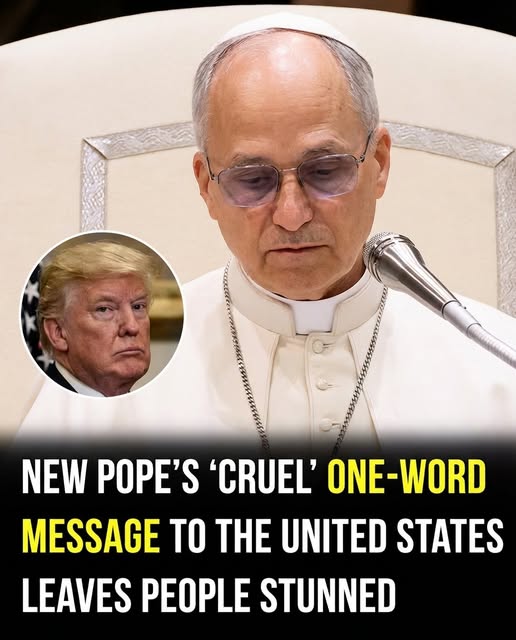
Pope Leo XIV: A Moment of Profound Simplicity that Resonated Globally
In a world where the significance of statements is often measured in their length and complexity, a remarkable moment recently captured the attention of millions. This event took place shortly after the inauguration of Pope Leo XIV, a figure whose background as a Chicago native adds a fascinating layer to his leadership. During a press conference that was broadcasted to international audiences, he faced a pivotal question that resonated deeply, especially among Americans: did he have a message specifically for the United States?
In response, Pope Leo XIV took a brief moment of reflection before delivering a single, impactful word—“Many.” This one-word response, imbued with simplicity yet depth, sent ripples through the media landscape almost instantaneously. The Pope then offered a traditional blessing and quickly moved on, but the implications of his reply lingered. Within moments, social media exploded with interpretations, critiques, and discussions, creating a wave of engagement that highlighted the power of concise communication.
The Power of One Word
In an era where leaders often rely on carefully crafted statements filled with political jargon, Pope Leo XIV’s choice to respond so succinctly felt revolutionary. The word “Many” could be seen as emblematic of a new approach to communication for the Catholic Church—one that invites contemplation rather than issuing edicts. Observers and commentators began to dissect the meaning behind his word, leading to a plethora of interpretations. For some, the word encapsulated the myriad strengths and responsibilities that the United States holds on a global scale, emphasizing unity and collaboration. Others interpreted it through a more critical lens, suggesting that it alluded to the numerous challenges the country currently faces, including social inequality, economic strife, and pressing moral dilemmas.
Supporters of the Pope quickly pointed to his history of advocating for compassion, social justice, and open dialogue, suggesting that his use of the word “Many” was anything but evasive. Instead, it seemed to be a deliberate choice meant to stimulate thought, inviting listeners to contemplate the vast complexities surrounding American society. The Pope’s past work in social initiatives reinforces the idea that his intentions are rooted in a genuine desire for connection and understanding, rather than mere political maneuvering. His previous efforts in interfaith dialogue and community building resonate with this message, making it clear that he values inclusive discourse over divisive rhetoric.
The Digital Age and Its Influence on the Papacy
This viral moment also serves as a noteworthy example of how the papacy is adapting to the digital age. With the rapid spread of information on platforms like Twitter and Facebook, the Pope’s single word reached audiences far beyond the Vatican’s traditional confines. The accessibility of this moment makes it clear that the papacy is evolving, becoming more attuned to the channels through which people communicate and engage. In a world inundated with information, it is a testament to the fact that sometimes, simplicity can carry profound significance, breaking through the noise of complex rhetoric.
As Pope Leo XIV continues to navigate his papacy, expectations are high regarding his future messages and actions. Many anticipate that his initial brief yet impactful response will lay the groundwork for a more expansive dialogue as he delves deeper into the pressing issues facing not just the United States, but the world at large. His emphasis on the word “Many” seems to suggest a commitment to inclusivity and dialogue—values that resonate with a globally interconnected world. This moment also illustrates how the Catholic Church is striving to remain relevant in a rapidly changing society, seeking to engage with contemporary issues while maintaining its foundational principles.
Fostering Discussion and Reflection
For the moment, Pope Leo XIV’s understated reply has sparked an extraordinary phenomenon—it has unified voices in discussion, curiosity, and reflection. In a society often polarized by divisive rhetoric, the Pope’s choice to say less has opened a space for nuanced conversations about collective responsibility and the complexities of national identity. The lingering question remains: what does “Many” truly signify in the context of contemporary America? This inquiry has encouraged individuals from various backgrounds to engage with the implications of leadership, community, and global citizenship. It invites not only dialogue among leaders but also grassroots discussions that can reshape societal narratives.Moreover, the response has inspired a wave of grassroots initiatives aimed at addressing the very challenges that were hinted at by the Pope’s single word. Community organizations, non-profits, and everyday citizens have taken it upon themselves to embody the spirit of “Many,” coming together to tackle issues such as poverty, climate change, and social injustice. This grassroots movement underscores the potential for collective action, suggesting that a simple word can catalyze significant change, motivating individuals to look beyond their own circumstances and consider the broader implications of their actions.
In conclusion, the initial days of Pope Leo XIV’s papacy have demonstrated the enduring power of words, particularly when they are delivered with intention and thoughtfulness. The simplicity of “Many” resonates in a way that lengthy statements often fail to achieve. As society continues to grapple with multifaceted challenges, the Pope’s brief yet significant remarks remind us that sometimes, the quietest words can indeed carry the greatest weight, fostering connections and prompting essential conversations about our shared future. The Pope’s ability to communicate effectively in such a straightforward manner reaffirms the notion that authenticity and clarity can be more impactful than elaborate rhetoric, paving the way for a new era of communication within the Catholic Church and beyond.
















