
The Life and Legacy of James Hetfield: From Personal Struggles to Heavy Metal Icon
In the world of heavy metal, few stories resonate as deeply as that of James Alan Hetfield. His life, marked by profound pain and remarkable triumph, mirrors a cinematic journey that has captivated audiences worldwide. Hetfield, born on August 3, 1963, in Downey, California, emerged from humble beginnings far removed from the limelight. His lineage, with a mother who was a light opera singer and a father who drove trucks, set the stage for the intertwining of music and struggle that would define his career.
James Hetfield’s formative years were steeped in the strict doctrines of Christian Science, a faith that emphasizes spiritual healing and often eschews conventional medicine. This upbringing shaped not only his worldview but also his creative output. In a setting where faith superseded medical intervention, Hetfield’s childhood experiences were colored by isolation and an acute sense of disenchantment. Instead of attending health classes in school, he was often relegated to waiting in administrative offices, an experience that deepened his sense of alienation. The rigidity of his upbringing instilled a yearning to break free, which he would later express through his music.
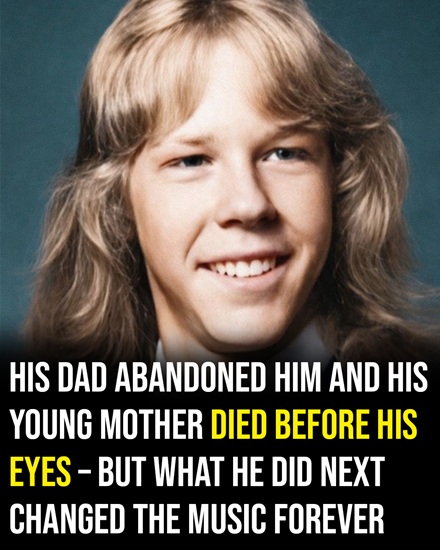
Musically inclined from a young age, Hetfield began taking piano lessons at the age of nine. However, his passion quickly shifted to drums and, later, guitar, as he self-taught his way through the riffs of iconic bands like Aerosmith, Black Sabbath, and Queen. The turbulent nature of his teenage life weighed heavily on him. His parents’ divorce in 1976 coincided with personal tragedy; shortly after, his mother succumbed to cancer, refusing medical treatment due to her religious beliefs. This loss, occurring when Hetfield was just 16 years old, profoundly impacted his psyche and served as a catalyst that would later be channeled into the emotionally charged lyrics of Metallica’s songs, such as “The God That Failed.” The haunting memories of his mother’s passing left an indelible mark on his songwriting, infusing it with themes of loss and longing.
Following his mother’s death, Hetfield moved in with his older half-brother, which provided a sense of stability during a chaotic period. This transition proved to be a pivotal moment for Hetfield, as he began to immerse himself in the local underground music scene, playing in bands like Obsession and Leather Charm. This early exposure allowed Hetfield to cultivate his songwriting skills while experimenting with various musical styles, from hard rock to the burgeoning punk scene. By the time he graduated from Brea Olinda High School in 1981, he was already recognized as a budding talent, honing his craft with an unrelenting drive and passion for heavy metal.
In a pivotal moment that would change the course of rock history, Hetfield answered an advertisement placed by drummer Lars Ulrich in The Recycler. This led to the formation of Metallica, a collaboration that ignited a creative fire that pushed the boundaries of heavy metal music. Hetfield and Ulrich’s partnership became the driving force behind the band’s unique sound, intertwining complex riffs with aggressive energy and evocative lyrics. The band’s early work, including iconic albums like Kill ’Em All and Ride the Lightning, established Metallica as a formidable force in the music industry, with their innovative sound evolving into a blend of speed and intricacy that captivated listeners and set a new standard for heavy metal.
As Metallica ascended to superstardom—particularly following the release of their self-titled album (often referred to as The Black Album) in 1991—Hetfield’s songwriting emerged as a defining voice of a generation. Hits like “Enter Sandman” and “Nothing Else Matters” resonated with fans, reflecting themes of personal struggle and resilience. However, the relentless pressures of fame and touring took a toll on Hetfield’s mental and emotional health. Behind the scenes, he battled with alcohol addiction and unresolved grief, which often manifested in turbulent relationships both within the band and with those closest to him.
A transformative moment arrived in 2001 when Hetfield made the courageous decision to enter a rehabilitation program to confront his addiction and anger issues. This pivotal choice was documented in the film Metallica: Some Kind of Monster, which peeled back the layers of the band’s internal struggles and revealed Hetfield’s journey toward healing. Instead of shying away from his challenges, he faced them head-on, earning respect not only as a musician but also as a courageous individual willing to confront his past. His experience in rehab became a turning point, helping him to cultivate a healthier relationship with himself and his art.
Transitioning into family life, Hetfield married Francesca Tomasi in 1997, and together they welcomed three children, further grounding him and providing a sense of purpose. This new chapter brought joy and responsibility, helping to reshape his worldview. His experiences with sobriety and family life encouraged a deeper introspection regarding spirituality, leading him to incorporate personal beliefs into his music. This evolution is evident in Metallica’s later work, which reflects a more nuanced understanding of life’s complexities, showcasing the duality of light and darkness that exists within each individual.
As we look towards the future, it is clear that Hetfield remains an enduring figure in music. Over four decades since founding Metallica, he continues to perform and record, driven by an insatiable passion for his craft. His legacy transcends mere commercial success; Hetfield’s journey from a troubled youth to an influential figure in heavy metal exemplifies the power of art as a means of healing and connection. His story reveals that even amidst darkness, resilience can illuminate a path toward purpose and profound creativity. James Hetfield has not only defined a genre but has also inspired millions around the globe, proving that even the most challenging experiences can yield extraordinary outcomes. As he continues to evolve as an artist and a person, Hetfield’s indomitable spirit stands as a testament to the transformative power of music.
















