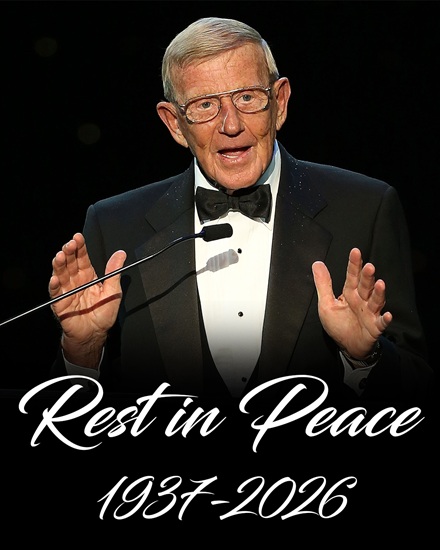
The Passing of a Legend: Remembering Lou Holtz
On March 4, 2026, the world of college football mourned the loss of one of its greatest icons, Lou Holtz, who passed away at the age of 89 in Orlando, Florida. His family confirmed the news, sharing that he was surrounded by loved ones in his final moments. While the exact cause of death was not disclosed, Holtz’s passing marks the end of an era, closing the chapter on a remarkable coaching career that spanned over three decades. Holtz’s impact went beyond mere statistics and victories; he was a mentor, a moral beacon, and a teacher of invaluable life lessons that resonated with players, students, colleagues, and fans alike.
Early Life and Introduction to Football
Born on January 6, 1937, in Follansbee, West Virginia, Lou Holtz emerged from the steel town environment of the Ohio River Valley, where sports were a vital part of community life. From an early age, he displayed an affinity for athletics, ultimately playing as a linebacker at Kent State University. His inherent leadership qualities and passion for the game became apparent during his college years, laying the groundwork for a future dedicated to the sport.
Holtz’s coaching journey commenced in 1960 as a graduate assistant at the University of Iowa, where he honed his coaching skills and developed a philosophy focused on teamwork and discipline. His ascent through the coaching ranks was swift, serving as an assistant at various institutions before securing his first head coaching position at William & Mary in 1969. This initial role provided a platform for Holtz to showcase his abilities, setting the stage for a legendary career.
A Career Marked by Transformations
Throughout the following 33 years, Lou Holtz became renowned for his transformative coaching style. His ability to rejuvenate underperforming teams became his hallmark, as evidenced by his tenures at six different college football programs, along with a brief yet impactful stint with the New York Jets in the NFL. At each stop, Holtz instilled a culture of excellence that prompted significant turnarounds.
At North Carolina State, Holtz honed his coaching philosophy, leading the team to consecutive winning seasons and boosting the school’s reputation within college football. His short tenure with the New York Jets in 1976 may not have yielded enduring success, but it served as a critical learning experience, reinforcing his commitment to the college game.
However, it was during his time at the University of Arkansas that Holtz truly emerged as a national figure. With a record of 60–21–2 and six consecutive bowl game appearances, he not only elevated the Razorbacks but also achieved a stunning upset over a top-ranked Oklahoma team in the 1978 Orange Bowl. His subsequent positions at Minnesota and then Notre Dame set the stage for what would become a career-defining legacy.
The Notre Dame Chapter: A Legacy Cemented
Lou Holtz joined the University of Notre Dame in 1986, stepping into a program in need of revitalization. Over his 11 seasons there, he achieved an impressive record of 100–30–2, marking the third-highest win total in the institution’s storied history. Holtz’s teams became synonymous with resilience, discipline, and toughness, earning their place as one of the toughest competitors in college football.
The zenith of Holtz’s Notre Dame tenure came in 1988 when his team finished undefeated at 12-0, clinching the consensus national championship. This historic season included a memorable victory against No. 1-ranked Miami, a game that solidified Holtz’s reputation as an exceptional strategist and motivator. Beyond wins, Holtz’s influence was instrumental in establishing lasting traditions at Notre Dame, including the now-iconic “Play Like A Champion Today” sign, which embodies the spirit of his coaching philosophy.
Post-Coaching Life and Continuing Influence
After leaving Notre Dame in 1996, Holtz transitioned to sports broadcasting with CBS Sports, where his insight and charismatic personality made him a beloved sports analyst. His ability to connect with audiences extended his influence beyond the football field, allowing him to share life lessons gleaned from years of coaching. Holtz authored several books and became a sought-after motivational speaker, using his platform to advocate for resilience, character, and integrity.
Lou Holtz’s commitment to faith and family also defined his life. A devout Roman Catholic, he often spoke about how his beliefs shaped his approach to coaching and leadership. His partnership with his wife, Beth, whom he cherished for nearly 60 years until her passing in 2020, exemplified his devotion to family and community service. The couple’s philanthropic efforts, particularly at Notre Dame, left a lasting impact that ensures their legacy endures.
A Lasting Legacy and Tributes
Holtz’s contributions to college football were acknowledged through numerous accolades, including his induction into the College Football Hall of Fame in 2008 and receiving the Presidential Medal of Freedom in 2020. However, the true measure of his legacy lies not in awards but in the countless lives he influenced—players who learned about loyalty and discipline, coaches who adopted his leadership principles, and fans who admired his teams. His faith-driven worldview and belief in the character-building potential of sports continue to resonate within American football culture today.
In the wake of his passing, tributes from across the sports community poured in, reflecting the profound impact Holtz had on the lives of many. Current and former players, coaches, and fans shared stories of how he inspired them, illustrating the depth of his influence within and beyond college football. Notre Dame, a place where his legacy is woven into the university’s fabric, paid special homage to him, recognizing that his impact extended well beyond the field.
As we remember Lou Holtz, we reflect on a life well-lived—a life dedicated to nurturing young individuals, fostering resilience, and promoting the values of faith and service. Holtz’s coaching philosophy transcended the sport itself, teaching lessons about life that will resonate through generations. His enduring spirit will live on in the many lives he touched, reminding us all that while he may have left the sidelines, his teachings and influence will forever remain a part of college football history.