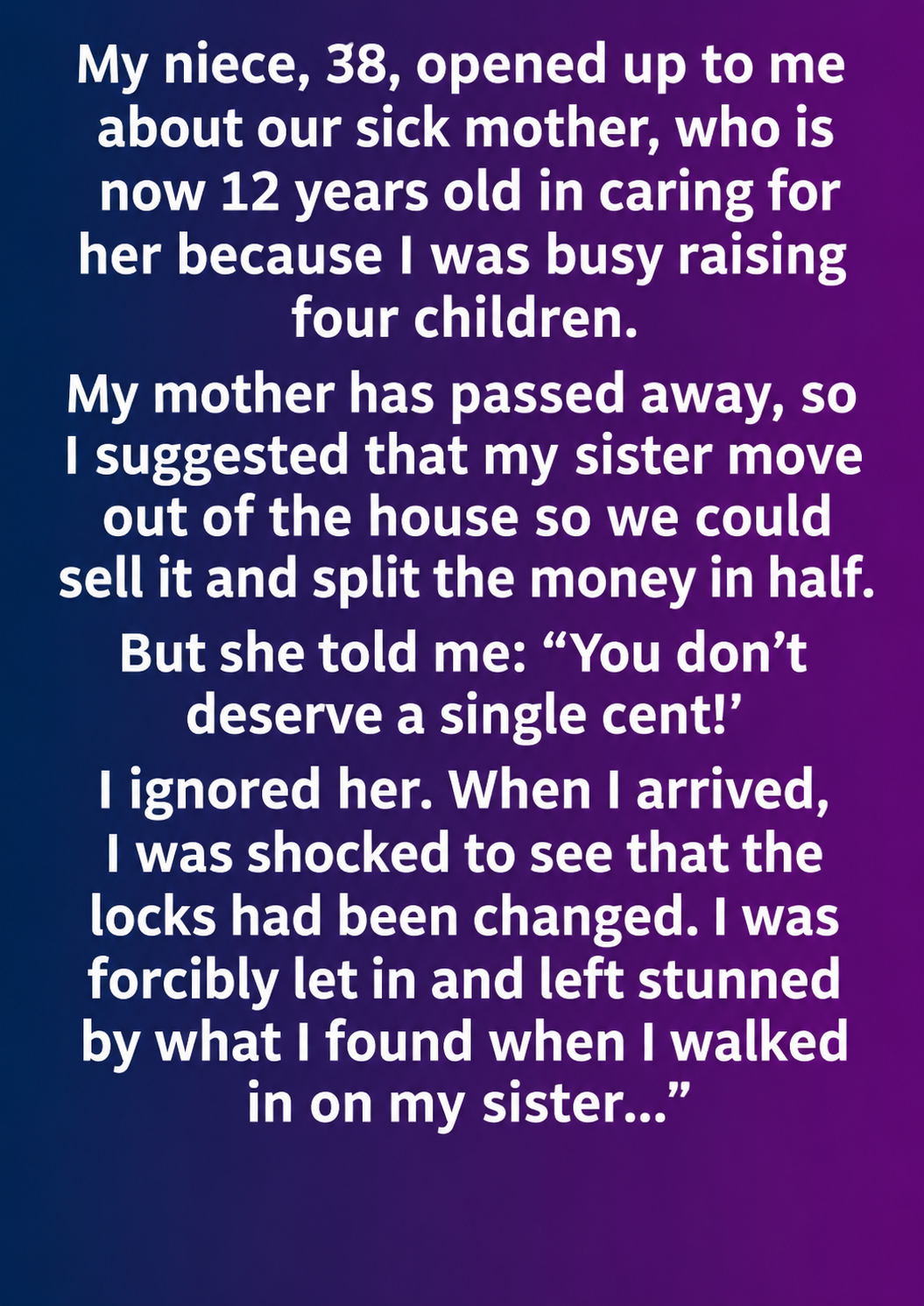
In today’s article, we bring you an interesting story about two sisters whose relationship was nearly destroyed by an inheritance dispute after their mother’s death. What initially appeared to be a straightforward disagreement over family property gradually exposed twelve years of sacrifice, loneliness, and painful misunderstandings.
One daughter had spent much of her adult life caring for their seriously ill mother, while the other had devoted herself to raising four children and managing her own household. When their mother passed away, the older sister assumed that the family home should be sold and the money divided equally. She believed this was a reasonable expectation because both women were daughters of the same mother. However, a visit to their childhood home revealed a devastating truth about everything her younger sister had endured in silence. What she discovered behind those familiar walls would change her understanding of family, responsibility, and love forever.
Emily was thirty-eight years old when her mother died, and her previous twelve years had been shaped almost entirely by caregiving. Their mother suffered from a progressive neurological condition that gradually made ordinary activities increasingly difficult. Emily organized medical appointments, monitored medications, prepared meals, and provided constant assistance as the illness advanced. Many nights passed without proper sleep because her mother needed reassurance, physical support, or help managing frightening moments of confusion. Meanwhile, her older sister was occupied with four children, household expenses, and the demands of family life. She frequently explained her absence by pointing to school activities, financial difficulties, or her husband’s demanding work schedule. Whenever she contacted Emily, she generally heard that everything was manageable and accepted those reassurances without further questions. What she failed to recognize was that her younger sister was gradually sacrificing her independence, financial security, and professional future to keep their mother safe.
The family’s situation changed permanently on a cold November morning when Emily announced that their mother had died peacefully during the night. Both daughters experienced grief, although their experiences of the preceding years had been very different. At the modest funeral, Emily appeared physically exhausted and emotionally overwhelmed by the loss of the person around whom her entire life had revolved. Her older sister embraced her and promised that they would support each other through the difficult period ahead. Unfortunately, that promise soon became overshadowed by practical questions concerning their mother’s property. Approximately three weeks after the funeral, the older daughter suggested selling the house and dividing the proceeds into two equal shares. She considered the arrangement fair and believed Emily could use her portion to establish a new home. Emily’s response was filled with pain because she understood that her sister was thinking about financial entitlement rather than the twelve years of care that had taken place inside that house. Their conversation escalated into accusations, and Emily eventually ended the call after declaring that her sister had no right to the inheritance she was demanding.
Two days later, the older sister arrived at the property determined to resolve the disagreement. She approached the entrance with her old key, expecting to walk into the home where she had spent her childhood. Instead, she discovered that the locks had been replaced, leaving her unable to enter. Furious, she repeatedly rang the doorbell and eventually contacted a locksmith, who refused to open the property without evidence of authorization. Before she could take further action, Emily returned from shopping and found her waiting outside. Their exchange was tense, and the older sister immediately demanded an explanation for the changed locks. Rather than continue arguing, Emily invited her inside to see what had happened during the years she had been largely absent. The moment she crossed the threshold, her anger began turning into an uncomfortable realization that she knew remarkably little about her mother’s final years. Photographs covering the hallway showed birthdays, hospital visits, holiday celebrations, and quiet afternoons shared between Emily and their mother, but the older daughter was absent from every image taken during those twelve years.
WHAT WE HIGHLIGHT: THE TWELVE NOTEBOOKS THAT REVEALED A MOTHER’S FINAL WISH
The most emotional discovery awaited upstairs in their mother’s bedroom, where twelve thick notebooks rested on a small wooden desk beside the window. Each notebook represented a different year, documenting experiences that the older daughter had never witnessed. During the earlier stages of her illness, their mother had recorded her thoughts personally, while later entries were written by Emily as her mother’s physical abilities deteriorated. The pages described hospital appointments, painful falls, exhausting evenings, and the mother’s repeated hopes that her other daughter would visit. One Christmas entry reflected her disappointment when the telephone remained silent despite her desire to hear from her absent child. Another recalled Emily injuring her back while helping her mother after a fall and quietly crying afterward. The older sister finally understood that while she had been explaining why she could not visit, her mother had been waiting and her sister had been struggling alone. Every page revealed ordinary moments of suffering and devotion that could never be recovered or compensated for with money.
The notebooks were only the beginning of Emily’s revelations. She produced financial records showing the considerable expenses associated with medical treatment, medication, nursing supplies, and modifications needed to make the house safer. Over the years, she had depleted her savings and even sold her car to cover essential costs. Emily also presented a resignation letter revealing that she had abandoned a promising career as a senior accountant when their mother could no longer live independently. The older sister was stunned because she had never realized the extent of those financial and professional sacrifices. When she asked why Emily had kept these difficulties secret, her younger sister showed her numerous old messages requesting assistance, temporary relief, or visits during medical emergencies. The painful truth was that Emily had asked for help repeatedly, but each request had been answered with another explanation about why her sister was unavailable. Faced with the evidence, the older daughter could no longer convince herself that she had simply been unaware of the family’s circumstances.
Then Emily opened a small metal box containing documents and a letter addressed to her older sister. The letter had been written by their mother before her death and explained the decision she had made regarding the family home. She expressed love for both daughters while acknowledging that Emily had surrendered years of independence to care for her without making her feel like a burden. Their mother understood that her older daughter had responsibilities of her own, but she also recognized who had remained beside her through illness, fear, and increasing dependence. Attached to the letter was a will leaving the entire property to Emily, prepared with legal assistance while their mother was capable of making such decisions. Supporting documentation included a physician’s statement concerning her mental capacity at the time. The house had not been secretly taken by Emily; their mother had deliberately left it to the daughter who had devoted twelve years to protecting her. The older sister realized that her assumptions about fairness had ignored sacrifices that could never be expressed through the market value of a property.
As the two women sat together, Emily explained that she had never cared for their mother because she expected a financial reward. Her greatest pain had come from watching their mother hope for visits that rarely happened. Even during periods of confusion, their mother continued asking about her older daughter and the grandchildren she missed. Emily revealed that on her final evening, their mother had once again wondered whether her absent daughter would come to see her. Hearing this left the older sister overwhelmed with regret, especially when she noticed a photograph carrying their mother’s handwritten request that the daughters look after one another. She apologized sincerely and announced that she would not contest the will or demand a share of the property. For the first time, the inheritance no longer mattered as much as the possibility of losing her sister permanently. Their conversation ended in tears and an embrace that marked the beginning of a difficult but meaningful reconciliation.
The following months brought gradual changes to their relationship as the older sister began visiting regularly and participating in the everyday responsibilities she had previously avoided. She helped with household repairs, organized belongings, and listened as Emily described years of exhaustion, isolation, and missed opportunities. Rebuilding trust was not immediate, and difficult conversations sometimes reopened old emotional wounds. Nevertheless, both women continued making an effort, recognizing that their mother’s final wish could still guide their future. Emily eventually began restoring her professional life through additional training and part-time employment, while her sister’s children developed a closer relationship with their aunt. Nearly a year after their mother’s death, the sisters sat together beneath an apple tree as the children played nearby. Their reconciliation demonstrated that although lost years cannot be recovered, people can still choose to become more present, compassionate, and responsible toward those they love. In my view, the most important lesson of this story is that family obligations should never be measured only through money or legal entitlement, because time, care, and emotional support often represent the greatest sacrifices. An inheritance may be assigned a financial value, but years of devotion cannot be divided into equal shares, and the opportunity to show love should never be postponed until it is too late. What would you do?