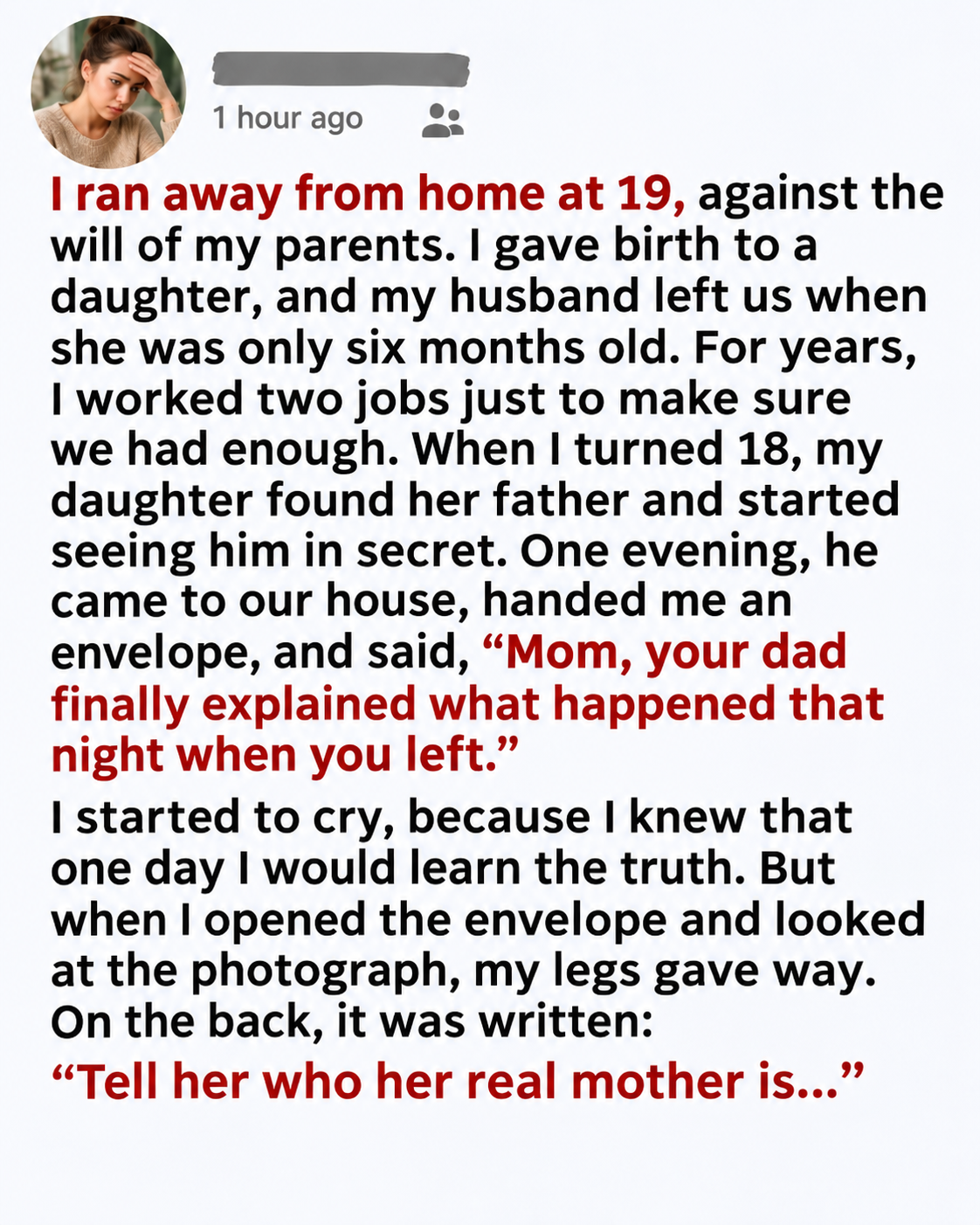
In today’s article, we bring you an interesting story about a mother whose eighteen years of sacrifice were suddenly overshadowed by a mysterious photograph and a family secret she had never fully explained. Married at just nineteen, she had believed that love would be enough to build a happy future, even though her parents strongly opposed her relationship.
Instead, she found herself raising a baby alone after her husband disappeared from their household. For nearly two decades, she worked tirelessly to provide her daughter with the security and opportunities she had once imagined sharing with her husband. Their relationship appeared strong, built upon years of difficult experiences and countless sacrifices. However, everything changed when the young woman reached adulthood and secretly reconnected with her absent father. One evening, she returned home carrying an envelope that raised a disturbing question about her own origins. What began as a confrontation over the past became a moment that threatened to change how both women understood their family.
The mother’s difficult journey began when she decided to marry a man despite her family’s objections. At nineteen, she was convinced that their relationship could survive whatever challenges lay ahead. Her parents disagreed with the marriage, but their concerns did not persuade her to abandon her decision. After the wedding, she welcomed a daughter and hoped that becoming parents would strengthen the relationship. Those expectations were shattered when the child was only six months old and her husband left the family home. Suddenly, the young woman had to face responsibilities she had expected to share with her partner. Instead of enjoying the early years of marriage, she found herself confronting financial uncertainty, emotional disappointment, and the overwhelming demands of caring for an infant alone. From that moment forward, her daughter’s well-being became the center of almost every decision she made.
The years that followed were dominated by exhausting schedules and financial responsibilities. To provide for her child, the mother worked two jobs, carefully managing whatever money remained after paying essential expenses. Her days revolved around earning enough to cover housing, food, clothing, and the countless needs that accompany raising a child. Despite the exhaustion, she continued trying to create a home where her daughter would feel loved and protected. The absence of her husband remained an important part of their family history, although the mother apparently avoided revealing every detail surrounding their separation. As her daughter grew older, questions about her father naturally became more significant. The mother had spent years protecting the life they had built together, but she could not control how her daughter would eventually interpret the missing pieces of their past. Those unanswered questions would become especially important when the girl reached her eighteenth birthday.
Becoming an adult gave the daughter an opportunity to make decisions independently, including one that would dramatically affect her relationship with her mother. Determined to learn more about the father she barely knew, she began searching for him without first discussing her intentions at home. Eventually, she succeeded in locating him and arranged meetings that she kept secret. Through those conversations, she started hearing his version of the marriage and the circumstances surrounding his departure. For the first time, she was receiving explanations from someone who had been absent throughout her childhood. Those conversations apparently challenged what she had previously understood about her parents’ separation. Instead of simply accepting that her father had abandoned the family, she began questioning whether her mother had concealed important information about why he left. The growing uncertainty eventually led her to confront the woman who had raised her.
One evening, the daughter returned home carrying an envelope that immediately became the focus of a tense conversation. Rather than greeting her mother in the usual way, she presented the envelope and referred to what her father had recently told her. According to the daughter, he claimed that her mother had forced him to leave the family home years earlier. The accusation sharply contradicted the explanation the mother had previously given about being abandoned with a six-month-old baby. For the older woman, hearing her daughter repeat this alternative version of events was emotionally overwhelming. She understood that the past she had avoided discussing was finally becoming impossible to ignore. Yet the most unsettling part of the encounter was not the accusation about the failed marriage, but the mysterious material the daughter had brought home. Within moments, the conversation would move beyond the circumstances of the separation and toward a much more personal question.
WHAT WE HIGHLIGHT: THE PHOTOGRAPH THAT RAISED QUESTIONS ABOUT THE DAUGHTER’S IDENTITY
When the mother opened the envelope, she discovered a photograph accompanied by a handwritten message. The story does not describe exactly who appeared in the picture or when it had been taken, but its effect on the woman was immediate. She became visibly distressed, as though something she had feared confronting had unexpectedly returned. The message on the reverse side was even more troubling because it instructed her to tell the daughter who her real mother was. Until that moment, the disagreement had focused on whether the father had abandoned the family or had been forced to leave. Now, the photograph appeared to challenge something far more fundamental: the young woman’s understanding of her own identity and family history. The mother was left facing a question that could not easily be answered through explanations about marital problems or financial hardship. Whatever the message meant, it introduced a mystery that went far beyond the original dispute.

The emotional weight of the discovery was intensified by the eighteen years the two women had spent together. The mother had been present through the daughter’s earliest experiences, childhood illnesses, school responsibilities, and the ordinary challenges of growing up. She had worked long hours to provide the necessities of life and had become the central figure in her daughter’s upbringing. From the daughter’s perspective, however, the envelope introduced the possibility that important information about her past had been withheld. The father’s earlier accusations had already created uncertainty, and the handwritten message now made that uncertainty even more difficult to resolve. The central question was no longer simply why her parents had separated, but whether the daughter had been given a complete and accurate account of her origins. Neither the mother’s years of sacrifice nor the father’s recent explanations could independently answer what the photograph was intended to reveal.
It is important to recognize that the message itself does not establish the daughter’s biological parentage. The available account does not identify the people shown in the photograph or explain who wrote the words on its reverse side. It also does not provide evidence confirming whether the father’s version of the separation was accurate. Although the mother admitted that she had expected her daughter to learn something about the past eventually, the precise nature of that secret remains unclear. There could be circumstances surrounding the family’s history that have not been included in the narrative. For that reason, it would be misleading to conclude that the woman who raised the girl was not her biological mother simply because the photograph contained such a message. The only certainty within the described events is that the envelope introduced an extraordinary question that neither woman had anticipated addressing that evening.
For the daughter, the situation presented an emotional conflict between curiosity about her past and loyalty to the person who had raised her. She had every reason to want answers about a father who had been absent for nearly her entire childhood. At the same time, the mother’s years of involvement in her daily life could not be erased by a single conversation or mysterious photograph. The young woman now faced competing accounts from two people whose relationship had ended long before she was old enough to remember it. Her father had recently become part of her life, while her mother represented almost everything familiar about her childhood. The challenge was not simply deciding whom to believe, but discovering whether either explanation contained the full story. Such a discovery would require patience, honest communication, and potentially reliable documentation rather than assumptions based on emotional accusations.
The mother’s position was equally complicated because her sacrifices did not automatically resolve the unanswered questions surrounding the girl’s birth and early childhood. Raising a child alone requires enormous commitment, especially when financial circumstances demand long working hours and continuous personal sacrifices. Nevertheless, providing love and stability does not necessarily eliminate a child’s need to understand their origins. The daughter had reached an age when exploring family history was a natural part of developing an independent identity. Her decision to contact her father secretly may have been painful for her mother, but it reflected a desire to understand experiences she had never witnessed. The most difficult part of their confrontation was that both women appeared to be carrying legitimate emotional needs while confronting information that neither was prepared to process. Their relationship had been shaped by nearly two decades of shared life, yet the unanswered questions threatened to create distance between them.

The father’s reappearance also complicated the situation because his claims became the immediate reason for the daughter’s confrontation with her mother. After eighteen years of absence, he had an opportunity to present his interpretation of events without the daughter possessing independent memories of the marriage. His allegation that he had been forced to leave challenged the mother’s explanation, but the narrative offers no supporting details that would establish which version was correct. The photograph introduced another layer of uncertainty without resolving the original disagreement. It remains unknown whether the father supplied the image, who wrote the message, or what specific circumstances prompted it. These missing details are essential because a serious claim about someone’s parentage cannot be treated as established truth without reliable evidence. The daughter therefore found herself confronting a complicated family history in which emotional testimony and unanswered questions were deeply intertwined.
The account ends at the moment when the mother discovers the photograph and reads the message written on its back. It does not describe a subsequent explanation, an examination of family records, or any confirmation of what the message actually meant. Readers are therefore left with the same central uncertainty facing the young woman: what truth had remained hidden, and why had it never been openly discussed? The years of separation, the mother’s struggles, and the father’s sudden return all contribute to the emotional intensity of the situation. Yet the most important missing element is the explanation that could connect these events into a complete family history. The photograph may have opened the door to a long-hidden truth, but the available story does not reveal what that truth is. Any specific conclusion about the daughter’s biological mother would go beyond the information provided.
This emotional family narrative raises broader questions about trust, parenthood, and the importance of honesty when children begin searching for answers about their origins. The mother devoted nearly eighteen years to raising her daughter under difficult circumstances, demonstrating a commitment that deserves recognition regardless of the unresolved mystery. The daughter, meanwhile, had an understandable desire to learn more about the father she had barely known and the circumstances surrounding her early childhood. Their confrontation illustrates how painful it can become when family histories contain unanswered questions that are only addressed after many years. **In my view, the most